
IPPT Calculator and the NSman Lifecycle: Your Complete Guide to Points, Awards & Reservist Life
If you have ever finished your push-ups, sit-ups and 2.4km run and wondered what it all adds up to, an IPPT calculator is the quickest way to find out. Instead of flipping through scoring charts, you key in your reps and run time and get your total instantly. This guide explains how IPPT points are worked out, what each award is worth, and where IPPT fits into the bigger NSman lifecycle, from enlistment all the way to the MINDEF Reserve.
What Is IPPT, Exactly?
IPPT stands for Individual Physical Proficiency Test. It is the regular fitness check for Singapore’s NSFs, NSmen and regulars. The current format has push-up and sit-up stations plus a 2.4km run, which together measure strength and cardiovascular fitness.
It is not just a pass-or-fail exercise. The better you perform at each station, the more points you earn, so a strong effort is always rewarded.
How the IPPT Scoring System Works
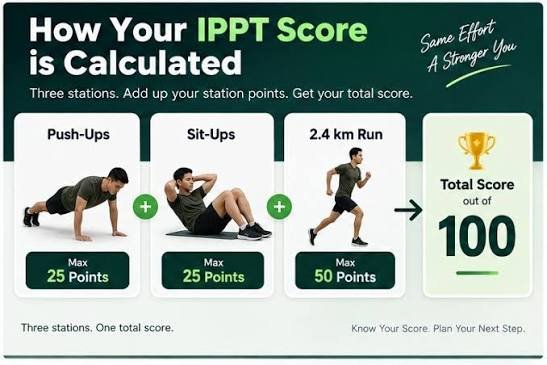
The IPPT scoring system is built on 100 points shared across three stations.
Push-Ups: 25 Points
Push-ups are worth a maximum of 25 points. You have one minute, and only clean, full repetitions count. Many people gain points here quickly with regular practice.
Sit-Ups: 25 Points
Sit-ups also carry a maximum of 25 points in the same one-minute format. Core endurance improves steadily, so this station is often the easiest place to pick up extra marks.
2.4km Run: 50 Points
The run is worth 50 points, double either of the other stations. It carries as much weight as push-ups and sit-ups combined. If you want a big jump in your total, your running pace is usually the best place to start.
IPPT Pass, Silver and Gold: Points and Cash Incentives
Here is how the IPPT points table breaks down into awards for NSmen:
| Award | Total Points | Cash Incentive |
| Pass | 51–60 | $0 |
| Pass with Incentive | 61–74 | $200 |
| Silver | 75–84 | $300 |
| Gold | 85–100 | $500 |
Commandos, Divers and Guards are held to a higher Gold standard of 90 points or more. Also, the pass mark is 61 or above for NSFs and regulars, versus 51 for NSmen. Always confirm the latest figures on the official NS Portal, since incentive details can be updated.
The NSman Lifecycle: Where IPPT Fits In
IPPT is not a one-off test. It comes back year after year, so it helps to see the whole journey. Here is the NSman lifecycle in plain terms.
Stage 1: Enlistment and Full-Time NS
Young men serve as full-time national servicemen (NSFs) in the SAF, Singapore Police Force or SCDF, and then move into an operationally ready reservist state as NSmen. Full-time service generally runs about two years. There is also a perk for fitness: combat-fit pre-enlistees who pass IPPT before enlisting can have full-time NS shortened to one year and ten months. So fitness pays off right from day one.
Stage 2: ORD, the Big Milestone
ORD, or Operationally Ready Date, marks the end of full-time service. After ORD, a serviceman becomes an NSman and begins his Operationally Ready National Service (ORNS) journey, typically a 10-year training cycle.
Stage 3: The ORNS Training Cycle
This is the longest stretch of the lifecycle. A few key points:
- The work-year: An active ORNS year means taking part in an ORNS activity between 1 April and 31 March, with no more than 40 days of activities called per year.
- In-Camp Training (ICT): A High Key ICT is one that lasts seven days or more.
- Completion: An NSman completes the cycle after at least 7 High Key ICTs and 10 active ORNS years.
Many NSmen also find it useful to keep their employer informed early, since call-ups can affect work schedules.
Stage 4: Annual IPPT and NS FIT
During the ORNS years, IPPT is part of the routine. This is the perfect time to use a good IPPT calculator to set a target for Silver or Gold for your age group.
If a test does not go well, there is a safety net. Remedial Training was replaced in 2021 by the 10-session NS FIT programme, which applies to NSmen who score below 51. Many see it as free, guided training rather than a punishment.
Stage 5: Statutory Age and the MINDEF Reserve
Eventually the reservist duties wind down. An NSman remains an NSman until the statutory age of 50 for officers and 40 for warrant officers, specialists and enlistees. After completing ORNS, you move into the MINDEF Reserve and no longer take IPPT or get called up for ORNS activities.
Using an IPPT Calculator Step by Step
Using an IPPT calculator takes less than a minute:
- Select your age group.
- Enter your number of push-ups and sit-ups.
- Enter your 2.4km run time in minutes and seconds.
- Read your station-by-station points and your total.
A good IPPT score calculator does more than add numbers. Some tools also tell you how many points you are away from the next tier and which station is holding you back. That makes it handy for setting realistic targets, such as “four more points to Gold.”
Whether you call it an IPPT points calculator or a score checker, the idea is the same: know exactly where you stand before test day.
Why Age Group Matters
Scoring is not the same for everyone. There are 14 age groups, running from below 22 up to 58–60. Older age groups need fewer reps or can run slower for the same points. Always choose your correct age band, because a result for the wrong group can mislead you.
Simple Tips to Raise Your IPPT Score
- Start with the run. With 50 points available, even small time improvements pay off. Mix easy runs, intervals and one longer steady session each week.
- Train push-ups in sets. Practise several short sets through the week rather than one exhausting attempt.
- Build your core. Planks and controlled sit-ups help you stay strong through the whole minute.
- Be consistent. A focused block of about 8 to 12 weeks, training three to four times a week with proper recovery, is enough for many people to move up a band.
- Recalculate often. Re-enter your numbers every couple of weeks to see real progress.
Frequently Asked Questions
What is a good IPPT score?
A score of 75 or more is generally considered good, since it earns Silver or Gold.
How many points do I need for IPPT Gold?
NSmen need 85 points or above.
How long does an NSman serve after full-time NS?
Typically a 10-year ORNS cycle, with reservist obligations lasting until statutory age.
Is the IPPT calculator official?
Most online tools are estimates based on published MINDEF tables. Final scoring and awards are decided by your unit and the SAF.
Final Thoughts
From enlistment to ORD, and from annual ICT to the MINDEF Reserve, the NSman lifecycle is a long journey, and staying fit makes every stage smoother. With a reliable IPPT calculator, steady training and a clear target, moving from Pass to Silver, or Silver to Gold, becomes a very doable goal. Test yourself, calculate your points, and keep improving.


